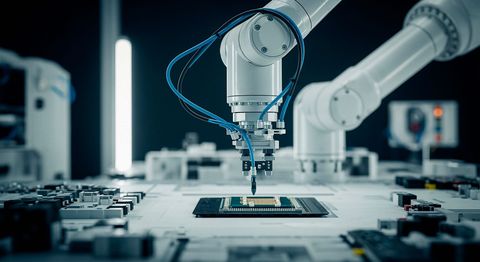
Industrial Sensor Futures Guide: Learn the Basics, Details, and Industry Knowledge
Industrial sensors are devices that detect physical, chemical, or environmental conditions and convert them into signals that monitoring systems can interpret. They measure variables such as temperature, pressure, flow, liquid level, vibration, position, humidity, and proximity. These measurements help industrial equipment operate within defined limits and provide information about production processes.
Introduction to Industrial Sensors
Industrial sensors are used in manufacturing plants, power generation, water treatment, food processing, pharmaceutical production, transportation, and warehouse automation. They may operate independently or connect to programmable logic controllers (PLCs), supervisory control and data acquisition (SCADA) systems, and industrial Internet of Things (IIoT) platforms.
As factories adopt more connected technologies, industrial sensors are becoming an important part of data-driven operations. Industrial sensor manufacturers develop devices for different environments, measurement ranges, accuracy requirements, and communication protocols. Selecting suitable equipment requires an understanding of the application, operating conditions, and expected performance.
How Industrial Sensors Work
A sensor detects a change in its surroundings and converts that change into a measurable output. Depending on its design, the output may be an electrical signal, a digital value, a wireless message, or another standardized signal.
A typical industrial measurement process includes:
Detection: The sensing element responds to a physical or chemical condition.
Signal conversion: Internal electronics convert the response into a usable signal.
Data transmission: The signal travels to a controller, display, monitoring platform, or connected device.
Interpretation: Software or control equipment compares the reading with configured limits.
Action: A system may display an alert, record the measurement, or adjust a process automatically.
For example, a pressure sensor in a water pipeline can transmit readings to a controller. If pressure moves outside a configured operating range, the control system can notify an operator or initiate a programmed response.
Not every sensor performs every step independently. Measurement, decision-making, and control may be distributed across several devices.
Main Types of Industrial Sensors
Industrial applications require different sensing technologies. Common categories include:
| Sensor type | What it measures or detects | Typical application |
|---|---|---|
| Pressure sensors | Pressure in gases or liquids | Hydraulic systems and pipelines |
| Temperature sensors | Thermal conditions | Furnaces, motors, and process tanks |
| Flow sensors | Liquid or gas movement | Water treatment and chemical processing |
| Proximity sensors | Presence or nearby objects | Conveyor and assembly systems |
| Level sensors | Liquid or solid material levels | Storage tanks and silos |
| Vibration sensors | Mechanical movement and vibration | Motors, pumps, and rotating machinery |
| Humidity sensors | Moisture in air | Warehouses and controlled environments |
| Position sensors | Location or displacement | Robotics and machine positioning |
The correct technology depends on the measurement range, material compatibility, environmental conditions, response time, and required accuracy. For example, an industrial pressure sensor supplier may provide different designs for clean water, corrosive chemicals, or high-pressure hydraulic applications.
Importance of Industrial Sensors in Modern Industry
Industrial sensors help organizations understand what is happening inside machinery and production processes. Their readings can support process control, equipment protection, quality checks, and maintenance planning.
Improving process consistency
Temperature, flow, pressure, and level measurements help operators maintain defined process conditions. Consistent monitoring is particularly important when small changes can affect product quality or equipment performance.
Supporting equipment reliability
Industrial vibration monitoring equipment can identify changes in machinery vibration that may indicate imbalance, misalignment, bearing wear, or other developing problems. Sensor readings provide useful evidence, although diagnosis often requires additional measurements and technical assessment.
Reducing unnecessary interruptions
Industrial condition monitoring systems can track operating patterns and help maintenance teams investigate abnormal readings before a fault causes a major disruption. The effectiveness of this approach depends on sensor placement, data quality, alarm configuration, and maintenance procedures.
Strengthening workplace awareness
Sensors can monitor temperature, gas concentrations, pressure, and other potentially hazardous conditions. When integrated into a properly designed safety system, they can help detect abnormal situations. Safety-critical applications require appropriate sensor ratings, independent safeguards where necessary, and documented testing.
Supporting energy and resource management
Monitoring compressed air, electricity, water, steam, and other process variables helps facilities identify unusual consumption patterns. Sensor data can support efficiency analysis, but measurable improvements depend on the actions taken in response to the findings.
Industrial Sensors in Automation and Connected Systems
Industrial automation sensor suppliers often work with manufacturers that need sensors to communicate with controllers, robots, production equipment, and monitoring platforms.
Common integration technologies include:
Analog signals: Such as 4–20 mA current loops and 0–10 V voltage signals.
Digital communication: Protocols such as IO-Link, Modbus, and industrial Ethernet variants.
Wireless communication: Technologies selected according to range, power requirements, reliability, and the industrial environment.
IIoT platforms: Systems that collect sensor readings for dashboards, analytics, alerts, and historical records.
Industrial IoT monitoring solutions can make information available across production and maintenance teams. However, connecting equipment to a network introduces cybersecurity considerations, including access control, network segmentation, secure configuration, and software maintenance.
Custom industrial sensor manufacturers may also develop specialized housings, sensing ranges, connection arrangements, or interfaces for applications that standard products cannot adequately address.
Recent Updates and Future Trends in Industrial Sensors
Industrial sensor development is increasingly connected with wireless monitoring, edge computing, artificial intelligence, and predictive maintenance. Developments reported during 2025 and 2026 illustrate how sensor data is becoming part of wider industrial decision-making systems.
Artificial intelligence and predictive maintenance
On November 24, 2025, SAS published findings from an IDC InfoBrief on AI and IoT adoption in manufacturing and energy. The report identified predictive maintenance as a prominent application of AIoT, highlighting the role of connected measurements in equipment monitoring. These findings describe surveyed organizations rather than guaranteed outcomes for every factory. Source: SAS.
Industrial AI and connected infrastructure
In March 2026, Cisco published its State of Industrial AI report, examining industrial AI deployment and infrastructure readiness. Its findings emphasized the importance of reliable networking, cybersecurity, and coordination between information technology and operational technology. These factors are relevant when industrial sensor systems feed data into AI-enabled monitoring platforms. Source: Cisco.
Wireless sensors and edge processing
Wireless industrial sensor systems can simplify monitoring in locations where running cables is difficult. Edge processing can analyze measurements near the equipment rather than transmitting every reading to a remote platform. The suitability of these approaches depends on connectivity, power availability, response-time requirements, and environmental conditions.
Future development areas
Smaller sensing components with improved integration.
More advanced vibration and condition-monitoring analytics.
Better interoperability between sensors and industrial controllers.
Increased attention to cybersecurity and device lifecycle management.
Greater use of historical sensor data to support maintenance planning.
These are technology directions, not guarantees that every new sensor will provide greater accuracy or lower operating expenses.
Laws, Policies, and Standards in India
Industrial sensors may be affected by measurement regulations, electrical safety requirements, product-specific rules, and workplace safety obligations. The applicable framework depends on the sensor's purpose, installation environment, and whether its readings are used for regulated transactions or safety-critical decisions.
Legal Metrology Act, 2009
India's Legal Metrology framework addresses measurement accuracy and specified measuring instruments. Certain instruments used for regulated measurements may require verification, stamping, or other prescribed procedures. Not every industrial sensor automatically falls under the same requirements. Check the official Department of Consumer Affairs Legal Metrology overview.
Bureau of Indian Standards
The BIS Act, 2016 provides the framework for Indian standards and conformity assessment. BIS certification is mandatory only when an applicable legal requirement, compulsory certification order, or Quality Control Order covers the relevant product. Industrial sensor manufacturers should confirm whether their particular equipment falls within an applicable category. See the BIS Act and regulations.
Electrical and machinery safety
Sensors installed in hazardous locations, industrial machinery, or safety-related systems may need to meet specific requirements for electrical protection, environmental resistance, hazardous-area suitability, or functional safety. Standards such as the relevant IEC 61508 and IEC 61511 frameworks may be relevant to functional safety applications, depending on the system and industry.
Calibration and measurement traceability
Industrial sensor calibration services help compare sensor readings with reference standards under specified conditions. Calibration records can document measurement error, uncertainty, and traceability where applicable. Calibration alone does not guarantee that a sensor is suitable for every application or that a complete process complies with regulations.
Requirements should be checked against current official publications and applicable industry standards before equipment selection or installation.
Tools and Resources for Selecting Industrial Sensors
Engineers and plant managers can use several resources to evaluate sensor suitability and plan an installation.
Manufacturer datasheets: Review measuring range, accuracy, repeatability, response time, environmental ratings, and electrical connections.
Calibration records: Examine calibration dates, measurement uncertainty, reference standards, and acceptance limits.
Sensor selection tools: Use technical selectors from manufacturers to compare pressure, temperature, flow, level, and proximity technologies.
PLC and SCADA documentation: Confirm signal compatibility, communication protocols, alarm settings, and data-recording requirements.
Industrial IoT dashboards: Monitor historical readings, identify unusual patterns, and review equipment conditions.
Maintenance templates: Record sensor identification, location, calibration history, inspection dates, and corrective actions.
Cybersecurity checklists: Assess device access controls, firmware updates, network segmentation, and remote connectivity.
When evaluating high-precision industrial sensors, review the full measurement specification rather than relying on an accuracy figure alone. Factors such as temperature drift, installation conditions, sensor ageing, and calibration uncertainty can affect practical performance.
Industrial sensor system integrators can also help assess how new devices fit existing automation systems, especially when several communication protocols or monitoring platforms are involved.
Frequently Asked Questions
What is the difference between a sensor and a transducer?
A sensor detects a physical or chemical quantity. A transducer converts one form of energy or signal into another. In industrial measurement, the terms sometimes overlap because many sensor assemblies include a sensing element and a signal-conversion mechanism.
How often should industrial sensors be calibrated?
There is no single interval for every sensor. The appropriate frequency depends on manufacturer guidance, operating conditions, measurement criticality, applicable regulations, and historical calibration results. Safety-critical or regulated applications may have specific requirements.
Are wireless industrial sensors suitable for every factory?
No. Wireless devices can be useful where cable installation is difficult, but radio interference, signal coverage, battery life, cybersecurity, and latency must be considered. Wired sensors may be more suitable for some continuous or safety-critical applications.
How can a factory choose an industrial sensor manufacturer?
Evaluate measurement specifications, application experience, technical documentation, environmental ratings, calibration arrangements, communication compatibility, and the availability of replacement components. Confirm that the proposed device meets the plant's engineering and regulatory requirements.
What is the role of industrial condition monitoring systems?
These systems collect and analyze measurements such as vibration, temperature, pressure, and current to assess equipment condition. They can help identify unusual operating patterns and support maintenance decisions, but findings should be interpreted alongside equipment history and appropriate technical checks.
Conclusion
Industrial sensors are essential components of modern automation, helping organizations measure process conditions, monitor equipment, and maintain operational awareness. Pressure, temperature, flow, level, proximity, and vibration sensors each address different measurement needs.
Future developments in wireless connectivity, edge computing, industrial IoT, and AI-supported analysis are expanding how factories use sensor data. However, effective implementation still depends on appropriate sensor selection, accurate installation, suitable calibration, cybersecurity, and ongoing maintenance.
By reviewing technical specifications, understanding applicable Indian regulations, and planning integration carefully, industrial teams can make informed decisions about sensor technologies that match their operational requirements.
Informational disclaimer: Sensor specifications, calibration intervals, equipment quotations, and implementation requirements vary by model, application, location, and supplier. Any preliminary estimate should be treated as indicative until confirmed against the relevant technical documentation and project requirements.

Related Post...

Explore Labeling Machines: A Complete Guide to Basic, Tips, and Industrial Insights
Updated: October 21, 2026
Read More
Discover Labeling Machines: An Overview of Types, Feature, and Useful Resources
Updated: October 22, 2026
Read More
Industrial Sensor Futures Guide: Learn the Basics, Details, and Industry Knowledge
Updated: October 22, 2026
Read More