Industrial Robots Information Guide: Explore Robotics Basics, AI-Powered Automation, Industrial Applications, Efficiency Tips, and Engineering Facts
Industrial robots have become an important part of modern manufacturing and automation. These programmable machines are designed to perform repetitive, precise, and physically demanding tasks that improve production efficiency and workplace safety. As industries continue adopting AI robotics, industrial IoT solutions, and robotic process automation software, industrial robots are becoming more intelligent, adaptable, and connected.
Today, industrial robotics supports sectors including automotive, electronics, food processing, pharmaceuticals, logistics, aerospace, metal fabrication, and warehousing. Modern automation is no longer limited to large factories, as advances in Industry 4.0, Industry 5.0, autonomous mobile robots, and machine vision systems are expanding robotic capabilities across different industrial environments.
Understanding Industrial Robots
An industrial robot is a programmable mechanical system capable of carrying out manufacturing or material-handling tasks with minimal human intervention. These robots combine sensors, controllers, motors, software, and mechanical components to complete operations accurately and consistently.
Modern robotic systems frequently integrate:
- AI robotics algorithms
- Industrial IoT solutions
- Machine vision systems
- Industrial robot programming
- Cloud-based monitoring
- Predictive maintenance software
- Robotic process automation software for digital workflows
- Enterprise automation platform integration
Unlike office automation software, industrial robots interact with physical equipment while exchanging operational data with factory management systems.
Why Industrial Robots Matter Today
Industrial automation continues to expand because manufacturers seek improved productivity, consistent quality, and safer working environments. Global supply chains have increased demand for intelligent production systems capable of operating efficiently with changing market requirements.
Industrial robots benefit many stakeholders:
| Industry | Primary Benefits |
|---|---|
| Automotive | Welding, painting, assembly, inspection |
| Electronics | Precision assembly and testing |
| Pharmaceuticals | Packaging and quality control |
| Food Processing | Sorting, packaging, palletizing |
| Logistics | Warehouse automation and material movement |
| Aerospace | Precision manufacturing and inspection |
Key challenges industrial robots help address include:
- Repetitive manufacturing processes
- Product quality consistency
- Workplace safety improvements
- Material handling efficiency
- High-precision production
- Production monitoring through industrial IoT solutions
- Data-driven manufacturing decisions
The evolution from Industry 4.0 toward Industry 5.0 also emphasizes collaboration between skilled workers and intelligent robotic systems rather than complete replacement of human expertise.
Types of Industrial Robots
Different industrial environments require different robot designs. Common industrial robot categories include:
| Robot Type | Typical Applications |
|---|---|
| Articulated Robots | Welding, assembly, painting |
| SCARA Robots | Electronics assembly, pick-and-place |
| Cartesian Robots | CNC operations, packaging |
| Delta Robots | Food packaging, sorting |
| Cylindrical Robots | Material handling |
| Polar Robots | Specialized manufacturing tasks |
| Collaborative Robots (Cobots) | Human-robot shared workspaces |
| Autonomous Mobile Robots (AMRs) | Warehouse transportation |
| Humanoid Robots | Research, inspection, advanced automation |
Articulated Robots
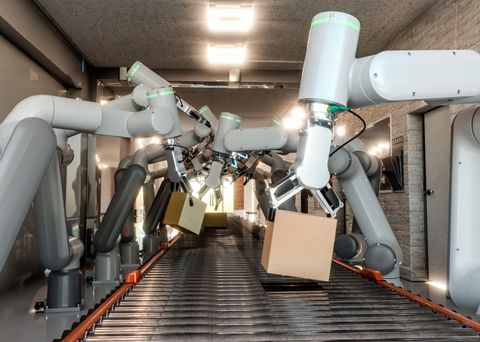
These multi-axis robotic arms closely resemble a human arm and are among the most common industrial robots.
Collaborative Robots
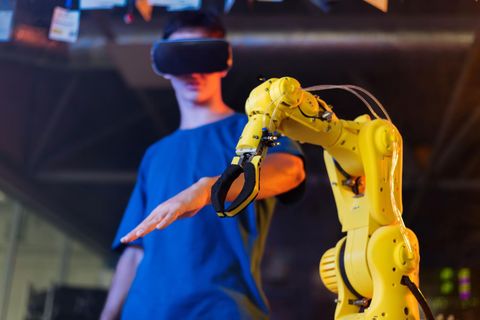
Collaborative robots are designed with advanced sensors that allow safe interaction alongside human workers during production processes.
Autonomous Mobile Robots
Unlike fixed robotic arms, autonomous mobile robots move independently throughout warehouses or production facilities using mapping and navigation technologies.
Humanoid Robots
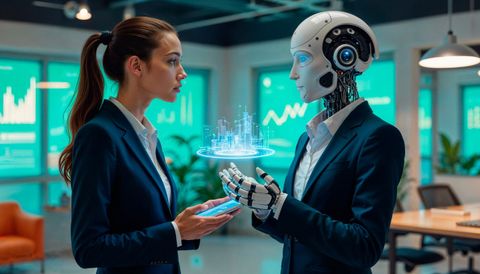
Although still emerging in industrial environments, humanoid robots are being evaluated for inspection, logistics support, and repetitive industrial operations requiring human-like movement.
Benefits and Industrial Applications
Industrial robotics provides measurable operational advantages across manufacturing sectors.
Improved Production Efficiency
Robots perform repetitive operations consistently while reducing production interruptions.
Higher Precision
Industrial robot programming enables highly accurate movements that reduce manufacturing variation.
Enhanced Workplace Safety
Robots can operate in hazardous environments involving:
- High temperatures
- Heavy materials
- Chemical exposure
- Repetitive lifting
- Hazardous machinery
Better Product Quality
Machine vision systems inspect products with consistent standards, helping identify manufacturing defects during production.
Data-Driven Manufacturing
Industrial IoT solutions collect operational data for:
- Equipment monitoring
- Predictive maintenance
- Energy optimization
- Production analytics
- Quality management
Flexible Manufacturing
Modern enterprise automation platform integration enables factories to adapt production schedules with greater efficiency.
Common applications include:
- Robotic welding
- Robotic painting
- Machine tending
- Material handling
- Pick-and-place operations
- Palletizing
- Packaging automation
- CNC loading
- Vision inspection
- Warehouse logistics
- Semiconductor manufacturing
- Pharmaceutical packaging
Leading Industrial Robotics Companies
Several global manufacturers continue advancing industrial automation technologies.
| Company | Known For |
|---|---|
| ABB | Industrial robots, automation systems, digital manufacturing |
| FANUC | CNC automation, robotic arms, factory automation |
| KUKA | Smart manufacturing, collaborative robotics |
| Yaskawa Electric | Motion control, robotic welding systems |
| Universal Robots | Collaborative robots (cobots) for flexible manufacturing |
These organizations continue investing in AI robotics, machine vision systems, industrial IoT solutions, and advanced industrial robot programming technologies.
Recent Industry Developments
Industrial robotics has experienced significant developments over the past year.
Recent trends include:
- Greater adoption of Industry 5.0 concepts focusing on collaboration between humans and intelligent automation.
- Expanded use of AI-powered machine vision systems for quality inspection.
- Increased deployment of autonomous mobile robots within logistics and warehouse environments.
- Continued investment in digital factory technologies using industrial IoT solutions.
- Improved robotic simulation software that shortens industrial robot programming and testing cycles.
- Growing interest in humanoid robots for selected industrial research and manufacturing applications during 2025–2026.
- Wider integration of enterprise automation platform software connecting robotics with production planning, inventory management, and predictive analytics.
Manufacturers are increasingly combining robotics with artificial intelligence, cloud computing, digital twins, and industrial cybersecurity to improve operational visibility.
Regulations, Standards, and Government Policies
Industrial robotics operates within safety regulations and engineering standards that vary by country.
Common international standards include:
- ISO 10218 for industrial robot safety
- ISO/TS 15066 for collaborative robots
- IEC functional safety standards
- Machinery safety regulations
- Occupational workplace safety requirements
Many countries also encourage advanced manufacturing through government-supported digital transformation initiatives associated with Industry 4.0 and smart manufacturing programs.
Organizations implementing industrial robots generally evaluate:
- Worker safety procedures
- Risk assessments
- Emergency stop systems
- Machine guarding
- Cybersecurity practices
- Data protection requirements
- Equipment maintenance documentation
Applicable regulations may differ depending on the country, industry sector, and workplace environment. Organizations typically consult local regulatory authorities and current engineering standards before deploying industrial robotic systems.
Helpful Tools and Learning Resources
Professionals and students can explore numerous educational resources for industrial robotics.
| Resource Type | Examples |
|---|---|
| Robot Simulation Software | ABB RobotStudio, FANUC ROBOGUIDE, KUKA.Sim |
| CAD Software | SolidWorks, AutoCAD |
| PLC Programming | Siemens TIA Portal, Rockwell Studio 5000 |
| Machine Vision | OpenCV, Cognex tools |
| Industrial IoT Platforms | Siemens Industrial Edge, Azure IoT, AWS IoT |
| Programming Languages | Python, C++, ROS |
| Learning Platforms | Industrial robotics training courses, engineering institutes, technical universities |
| Documentation | ISO standards, robotics manuals, engineering publications |
Useful learning topics include:
- Industrial robot programming
- AI robotics fundamentals
- Machine vision systems
- Industrial IoT solutions
- Enterprise automation platform architecture
- Robotic process automation software
- Predictive maintenance
- Digital manufacturing
- Cybersecurity for industrial automation
Industrial Robotics Technology Overview
Sensors
    │
    ▼
Machine Vision Systems
    │
    ▼
AI Robotics Software
    │
    ▼
Industrial Robot Programming
    │
    ▼
Robot Controller
    │
    ▼
Robotic Arm / Collaborative Robot / AMR
    │
    ▼
Manufacturing Process
    │
    ▼
Industrial IoT Solutions
    │
    ▼
Enterprise Automation Platform
Frequently Asked Questions
What is an industrial robot?
An industrial robot is a programmable machine designed to perform manufacturing, assembly, inspection, or material-handling tasks with high precision and repeatability.
How do collaborative robots differ from traditional robots?
Collaborative robots, often called cobots, are designed to operate safely alongside people using sensors, force limitations, and advanced safety features, while traditional robots commonly work within guarded areas.
What is Industry 4.0 in industrial robotics?
Industry 4.0 refers to smart manufacturing where robotics, industrial IoT solutions, cloud computing, AI, sensors, and data analytics work together to create connected production systems.
Why are machine vision systems important?
Machine vision systems allow robots to identify objects, inspect products, guide movements, measure dimensions, and improve manufacturing quality through automated visual analysis.
What skills are useful for industrial robotics?
Useful skills include industrial robot programming, PLC programming, mechanical engineering fundamentals, AI robotics concepts, industrial IoT solutions, automation controls, machine vision systems, and industrial robotics training.
Conclusion
Industrial robots continue transforming manufacturing through intelligent automation, improved precision, and connected production systems. Technologies such as AI robotics, robotic process automation software, industrial IoT solutions, machine vision systems, collaborative robots, and autonomous mobile robots are expanding the capabilities of modern factories while supporting the transition from Industry 4.0 to Industry 5.0.
As robotics technology evolves, organizations increasingly combine automation with human expertise to improve productivity, quality, workplace safety, and operational visibility. Continued learning in industrial robot programming, digital manufacturing, and engineering standards will remain valuable as automation technologies develop further.
Informational Disclaimer: This article is intended for educational and informational purposes only. Technology capabilities, industrial practices, regulations, implementation requirements, and any estimated budgets or project packages associated with robotics deployment can vary significantly by country, industry, facility size, and organizational requirements.

Related Post...